

Research
New porous materials
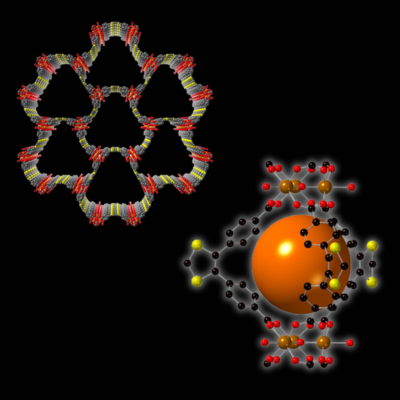
In this research line we undertake the synthesis of different types of crystalline porous materials, including extended porous metal-organic frameworks (MOFs), and more advanced solution-processable porous materials such as hydrogen-bonded organic frameworks (HOFs) and metal-organic polyhedra (MOPs). We cover from their synthesis with control over the crystalline size to their advanced physico-chemical characterization and further implementation. We investigate the potential of these novel porous materials for gas separations and carbon dioxide capture, as well as for sensing and for light-harvesting and photocatalysis.
Boosting Protein Encapsulation through Lewis-Acid-Mediated Metal–Organic Framework Mineralization: Toward Effective Intracellular Delivery”
Metal–organic frameworks for biological applications
Heteroepitaxial MOF-on-MOF Photocatalyst for Solar-Driven Water Splitting

Biohybrid Materials
We prepare biocomposites and nanoparticles based on biocompatible MOFs to be used as scaffolds for the encapsulation and controlled release of bioactive (macro)molecules, obtaining advanced delivery systems for improved therapies.
Boosting Protein Encapsulation through Lewis-Acid-Mediated Metal–Organic Framework Mineralization: Toward Effective Intracellular Delivery”
Metal–organic frameworks for biological applications

Bidimensional materials
From a coordination chemistry approach, we prepare 2D materials as an alternative to the classical inorganic compounds as graphene, MoS2 or MX3 (transition metal trihalides), taking advantage of the chemical design to introduce elusive properties in stable materials.